
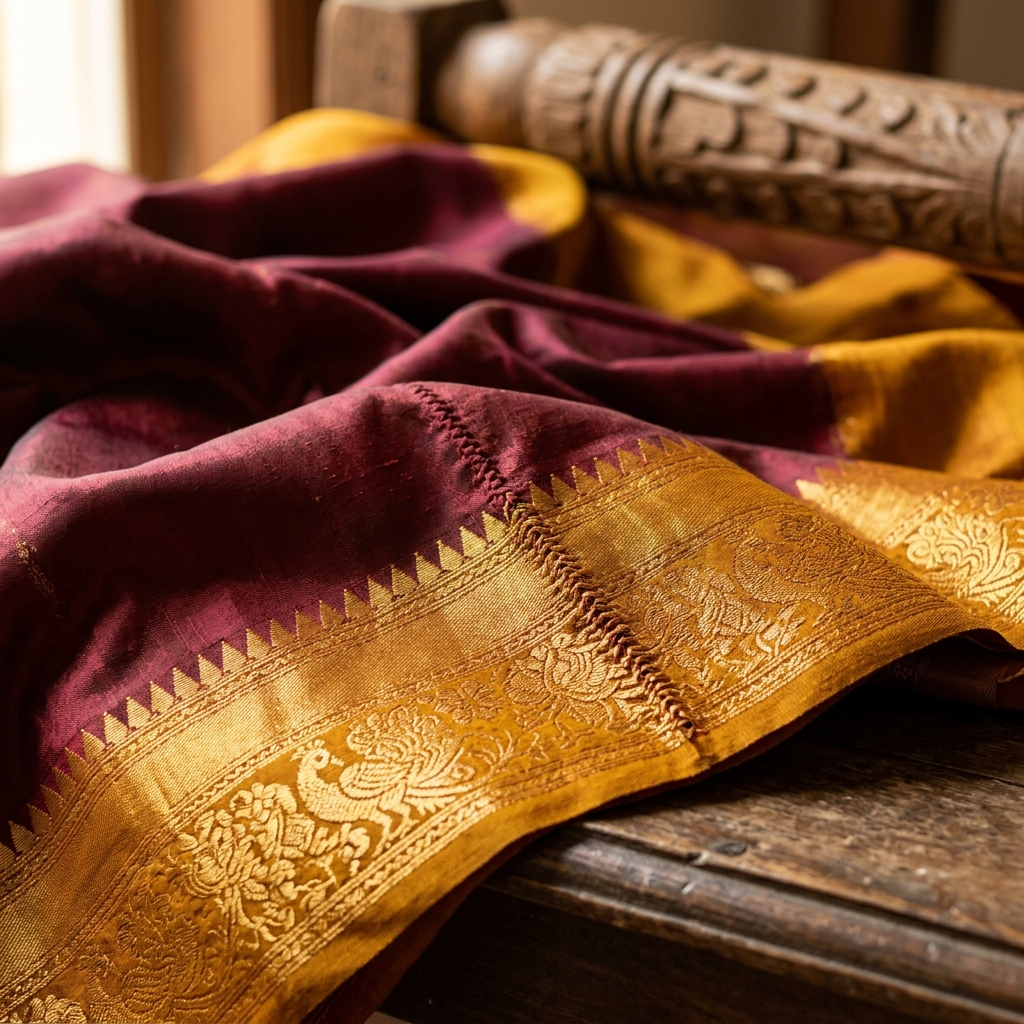
A real Kanjivaram is an heirloom — the kind of saree that gets worn at your daughter's wedding thirty years from now. But at ₹15,000 to over ₹1,00,000 a piece, it's also the saree people are most often tricked into overpaying for. Semi-silk sold as "pure." Machine zari passed off as gold. A dupe that looks gorgeous in photos and turns dull in six months.
Most guides you'll find online hand you the same in-store checklist — the burn test, the weight test — which is genuinely useful if the saree is already in your hands. But almost none of them answer the question real buyers ask in 2026: how do I verify a Kanjivaram I'm about to buy online, without touching it first?
We're Aikyatha — a handloom saree house in Bangalore that has been weaving and curating pure silks since 2018. Below are the 9 checks we'd genuinely use ourselves to spot a pure Kanjivaram silk saree, split into what you can verify from your phone before paying, and what you confirm the moment it arrives. No jargon, no scare tactics — just the tests that actually work.
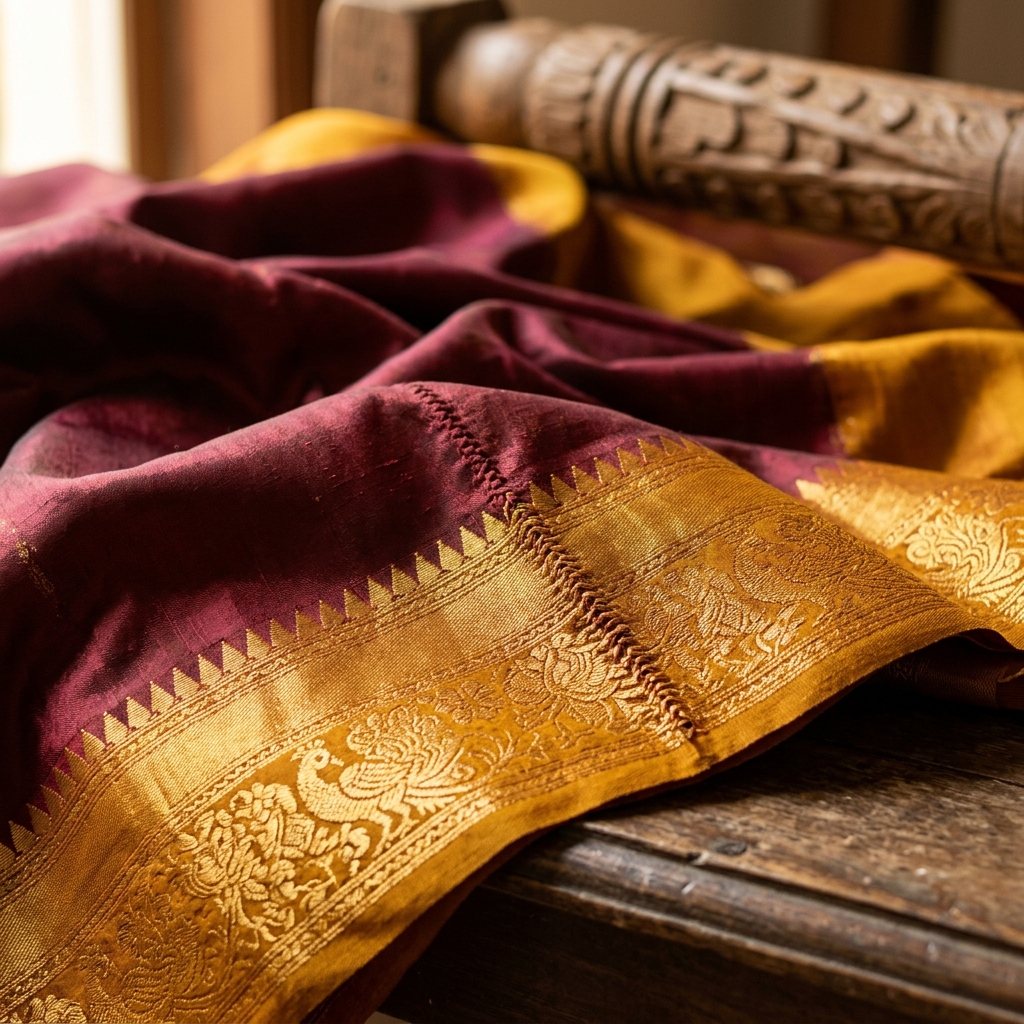
First, what a pure Kanjivaram silk saree actually is
Before the tests, one thing worth knowing — because it's the foundation for all nine.
A true Kanchipuram (Kanjivaram) silk saree carries a Geographical Indication (GI) tag, granted by the Government of India in 2005–06. That's not marketing — it's a legal standard. To be called a genuine Kanchipuram silk, the saree must be:
- Woven in the Kanchipuram region of Tamil Nadu using the traditional technique,
- Made from pure mulberry silk (the raw silk famously comes from Karnataka), and
- Woven with real zari — silk thread dipped in silver and gold. The official GI standard specifies roughly 57% silver and 0.6% gold in the zari (relaxed by Tamil Nadu to 40% silver / 0.5% gold).
Two technical fingerprints separate a real Kanjivaram from a lookalike, and you'll see them referenced in several tests below:
- Double-warp weave: each "thread" is actually three silk threads twisted together — which is why a genuine Kanjivaram feels substantial, not flimsy.
- Korvai technique: the contrast border and body are woven separately and interlocked by hand, leaving a distinct ridge on the reverse. A printed-border dupe can't fake this.
Keep those two words — double-warp and korvai — in your back pocket. Now, the tests.
Part 1 — Verify it BEFORE you pay (the online checks)
This is the part every other guide skips. You can't do a burn test on a web page, but you can do these four.
1. Ask for the Silk Mark certification — and actually verify it
The single most reliable proof of pure silk in India is the Silk Mark label, issued by the Silk Mark Organisation of India (an arm of the Central Silk Board, Ministry of Textiles). A genuine Silk Mark hologram tag carries:
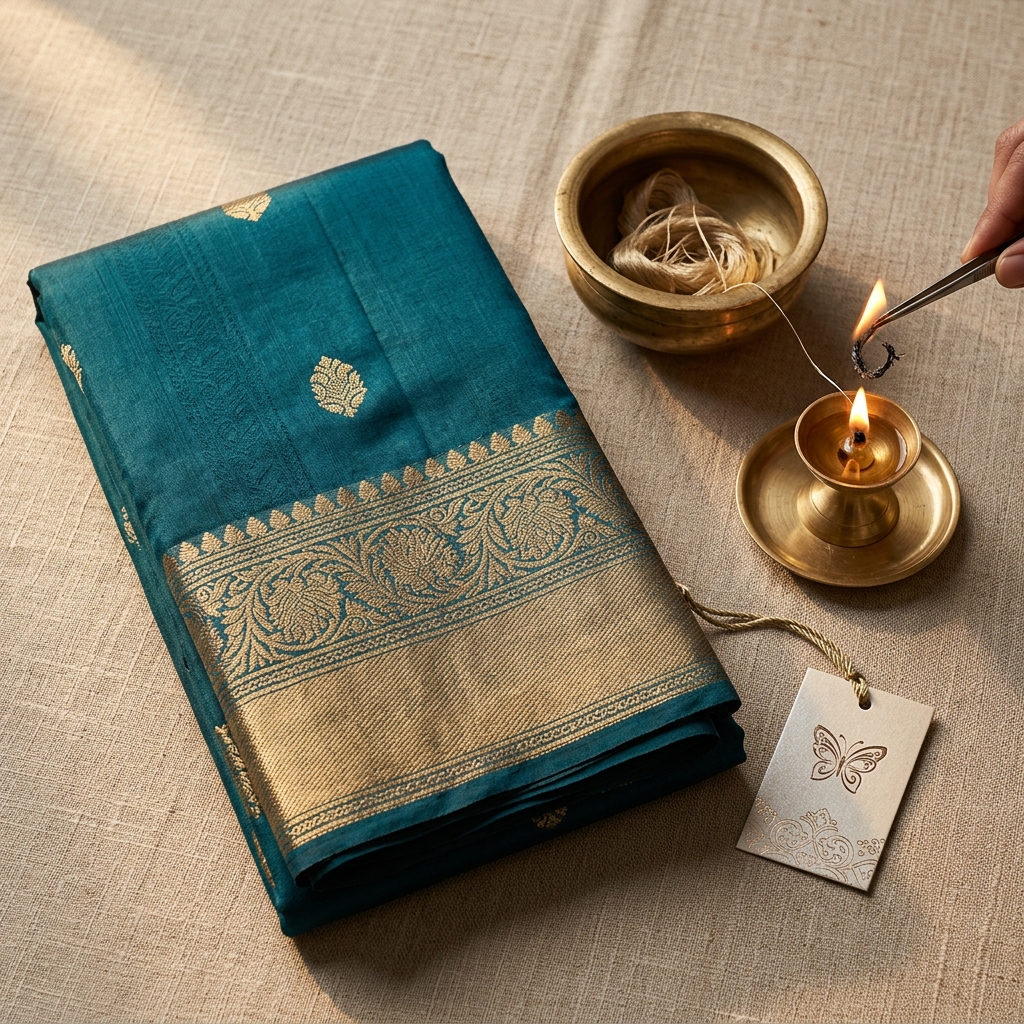
- A tamper-evident holographic butterfly logo,
- A unique alphanumeric code tied to the authorised seller, and
- A scannable QR code that reveals the seller's registered details.
How to use it online: ask the seller for a clear photo of the Silk Mark tag, then verify the code on the Silk Mark India portal. A trustworthy seller will send it without hesitation. If a "pure silk" listing has no Silk Mark and the seller gets vague when you ask — that's your answer. (Every pure silk piece we sell is verifiable; that's the whole point of buying weaver-direct.)
2. Demand a close-up of the reverse — look for the korvai ridge
Ask for a macro photo of the back of the border where it meets the body. On a real korvai Kanjivaram you'll see a subtle interlocked ridge — the join where border and body were woven separately. On a cheap dupe, the border is printed or attached, and the reverse looks flat and continuous. This one photo filters out a huge share of fakes.
3. Check the price against reality
If it feels too good to be true, it is. Here's an honest reference:
| Price band | What you're realistically getting |
|---|---|
| Under ₹5,000 | Art silk / polyester or heavy blend. Not pure Kanjivaram. |
| ₹8,000–₹15,000 | Entry semi-silk or light pure silk, thin zari. |
| ₹15,000–₹50,000 | Genuine pure Kanjivaram, real zari, everyday-to-occasion. |
| ₹50,000–₹1,00,000+ | Bridal-grade: heavy pure silk, dense/antique zari, fine korvai. |
A "pure Kanchipuram bridal saree" at ₹4,999 is not a deal — it's a different product wearing the name. Browse a genuine Kanjivaram collection and you'll quickly calibrate what real silk costs.
4. Use video before you buy
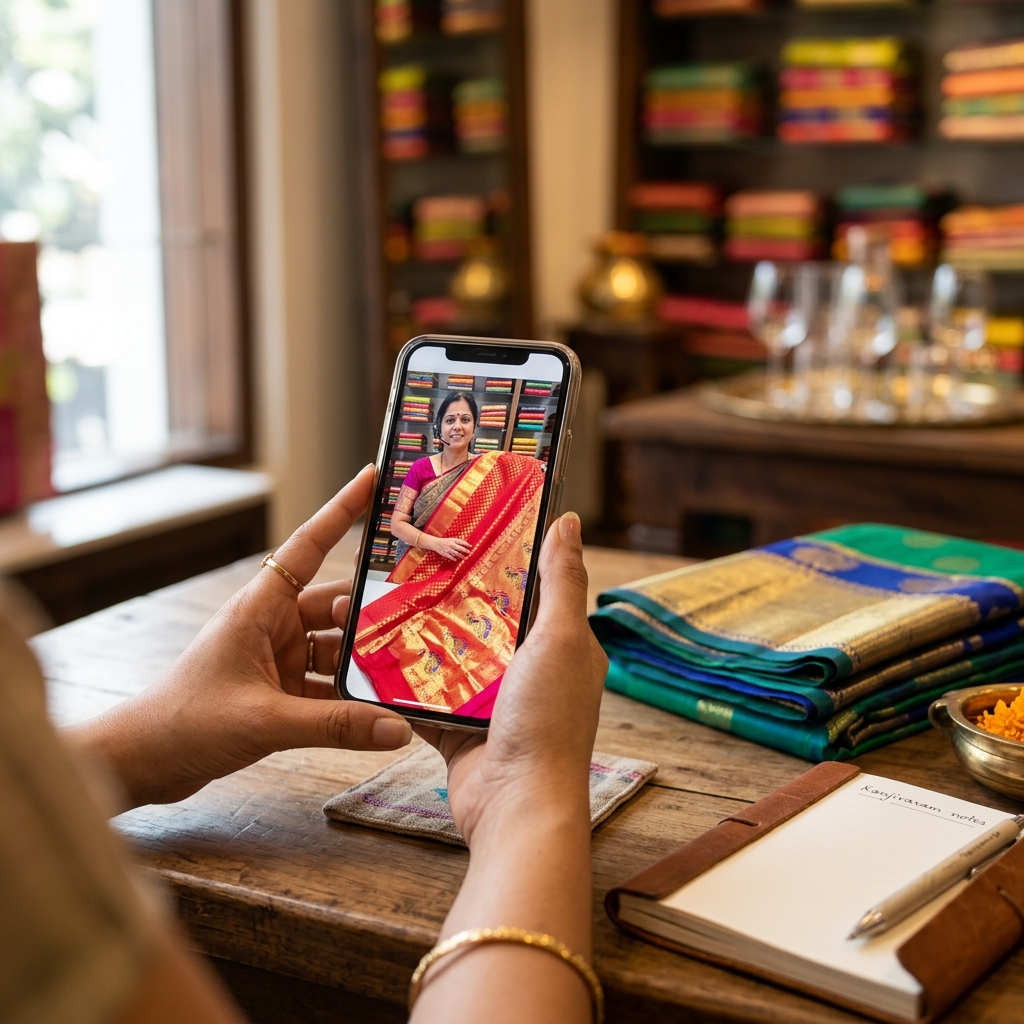
The smartest online buyers don't rely on still photos at all — they ask to see the saree live. At Aikyatha we run Virtual Shopping sessions over video call where you can watch the silk catch the light, see the zari up close, and ask us anything in real time. Any serious seller should offer some version of this. If they won't show it live, ask yourself why.
Part 2 — Confirm it the moment it ARRIVES (the in-hand tests)
Once the saree is with you, these five checks take five minutes and settle it for good.
5. The weight test
A pure Kanjivaram is heavy — genuine mulberry silk plus real zari typically brings a saree to 500–800 grams or more. That heft is the double-warp weave and metal zari doing their job. If a "pure silk" saree feels feather-light and slippery, it's likely art silk or a semi-silk blend.
6. The luster (sunlight) test
Take the saree into natural daylight and tilt it at different angles. Real silk has a multi-tonal glow — it seems to change colour subtly as light hits it, because silk fibres are triangular and refract light. A synthetic dupe shows a flat, white, one-note shine, or looks dull in the sun.
7. The zari scratch test
Gently run a fingernail along the zari thread. Real zari won't flake — it's silk wound with silver and gilded, woven into the fabric. If the golden coating scratches off or the thread underneath is white plastic, it's imitation zari. (Genuine old-style zari reveals a reddish-orange silk core, not white, under the metal.)
8. The korvai join, in person
Remember Test 2? Now confirm it by hand. Feel along the border-to-body join — on a real korvai saree it's firm and interlocked, sometimes with tiny loops visible at the seam. It shouldn't feel printed, glued, or stitched on.
9. The burn test (the last-resort proof)
Only if you still have doubts, and only on a stray thread from the fall or pallu: pull a single strand and burn it.
- Pure silk burns slowly, curls away from the flame, smells like burnt hair, and leaves a soft, crushable black ash.
- Synthetic melts, beads into a hard plastic ball, and smells chemical.
It's destructive by a millimetre, so save it for last — but it's the test that never lies.
Kanjivaram or Banarasi? A quick note
A lot of buyers confuse the two — and some sellers blur the line on purpose. In short: Kanjivaram is heavier South Indian mulberry silk with broad contrast borders and temple/checks motifs; Banarasi is lighter North Indian silk with intricate brocade. They're different weaves for different occasions, and we stock both — so if you're deciding between them, browse our Kanjivaram and Banarasi ranges side by side, or read our full comparison in Related reads below.
Buying for a little one? The same authenticity rules apply to kids' Kanjivaram pattu pavadai — just at a smaller scale.
The honest bottom line
You don't need to be a textile expert to avoid a fake Kanjivaram. You need three things: a verifiable Silk Mark, a clear look at the korvai border, and a price that makes sense. Do those before you pay, confirm the weight-luster-zari trio when it arrives, and you'll never be fooled.
And if you'd simply rather buy from a house that weaves and verifies its own silks — that's exactly what we do. Explore our pure silk saree collection, book a Virtual Shopping call, or ask about our Monthly Saree Scheme to build toward your dream Kanjivaram. Questions before you commit? Talk to us — no pressure, just straight answers.
📌 Frequently asked questions
Can I tell if a Kanjivaram is pure just from online photos? Not with 100% certainty — but you can get very close. Ask for the Silk Mark tag, a close-up of the reverse korvai border, and a live video view. Together those three rule out the vast majority of fakes before you pay.
Is Silk Mark the same as the GI tag? No. Silk Mark certifies the fabric is pure natural silk. The GI tag certifies it's a genuine Kanchipuram woven in the right region by the right technique. A top-tier saree ideally has both.
Why is a pure Kanjivaram so heavy? Because of the double-warp weave (three twisted silk threads per strand) and real silver-gold zari. That weight is a feature, not a flaw — it's why the saree holds its shape and lasts generations.
What's the minimum price for a genuine Kanjivaram? Realistically, genuine pure Kanjivarams start around ₹15,000. Anything claiming "pure Kanchipuram" under ₹5,000 is almost always art silk or a blend.
🔗 Related reads
- Kanjivaram vs Banarasi: Which Silk Saree Should You Actually Buy? (coming soon)
- Soft Silk vs Pure Silk Sarees — What's the Real Difference? (coming soon)
- A Parent's Guide to Buying Kids' Pattu Pavadai (coming soon)
- About Aikyatha — our looms, our story
Aikyatha is a handloom silk saree house based in Bangalore, weaving and curating pure Kanjivaram, Banarasi and soft silk sarees since 2018. Every pure silk piece is Silk Mark verifiable.



Share Product